What Are Engagement Signals in Email Filtering?


The short answer
Engagement signals are the actions recipients take on your mail — replying, moving it to the inbox, marking not-spam, deleting unread, or reporting spam. Mailbox providers like Gmail and Yahoo weigh these behaviours alongside authentication and reputation to decide inbox, importance, or spam. They publish which behaviours count, but not the exact weighting.
What are engagement signals in email deliverability? The recipient actions — replies, folder moves, spam reports — that providers weigh to place your mail.
On this page
What are engagement signals in email deliverability? They are the actions a recipient takes on a message — replying, moving it to the inbox, marking it not-spam, ignoring it, deleting it unread, or reporting it as spam. Mailbox providers like Gmail and Yahoo watch these behaviours and weigh them, alongside authentication and reputation, to decide where your mail lands. This glossary entry lists the signals that count and what each one tells the filter.
Two things make engagement signals confusing, so this post handles both. First, providers tell you which behaviours matter but not how much each one is worth — none of them publish the formula. Second, the same behaviours feed two different decisions: whether a sender's mail reaches inboxes at all, and whether your own inbox flags a specific message as important. This is the definition and the list; a companion post covers how much engagement moves deliverability and how to segment a list around it.
What counts as an engagement signal#
An engagement signal is any recipient behaviour a mailbox provider can observe and read as a vote on whether mail is wanted. They split cleanly into two groups: positive signals that say 'more like this,' and negative signals that say 'less.' A few are ambiguous — an open being the classic example. The table lists the common ones and what each tells the filter.
| Signal | What the recipient does | What it tells the filter | Direction |
|---|---|---|---|
| Reply | Writes back to the message | The recipient wanted a conversation | Positive — strong |
| Move to inbox / not-spam | Drags a message out of spam or Promotions | The filter was wrong; this sender is wanted | Positive — strong |
| Add to contacts / star / flag | Keeps the sender or message on purpose | Deliberate approval of the sender | Positive |
| Open or click | Views the message or a link | Weak, spoofable interest — Google says it does not track opens | Ambiguous |
| Delete without opening | Removes a message unread | The mail was unwanted at a glance | Negative |
| Weeks of no opens | Lets mail pile up unread | Interest has faded; the address may be dead | Negative — cumulative |
| Mark as spam | Presses the spam or report button | The strongest 'do not want' a person can send | Negative — very strong |
| One-click unsubscribe | Opts out cleanly | Wants out, but better than a complaint | Neutral to negative |
How mailbox providers use these signals#
Providers use engagement in two separate ways. The first is a reputation for the sender: they aggregate how everyone who receives a domain's mail behaves into a running score for that sending domain and its IPs, then apply it to the next message. Gmail states the rule plainly — send email only to people who want to get messages from you — and warns that if messages from your domain are frequently reported as spam, future messages from you are more likely to be marked as spam. Yahoo says the same in different words: send to an active and engaged audience, because sending to people who are not reading your mail will harm your delivery metrics and reputation.
The second use is personal and local to your own inbox. Gmail's importance markers use your individual behaviour — whom you email and how often, which messages you open, which you reply to, keywords in mail you usually read, and which you star, archive, or delete — to decide what to flag as important. Same raw behaviours, different decision: one scores a sender for everyone, the other scores messages for you. Confusing the two is where most misreadings of 'engagement' begin.
What providers publish — and what they don't
Negative engagement signals, and why one outweighs many positives#
Negative signals do more damage per event than positive ones do good, because they carry intent. A spam complaint is the clearest of all: Gmail ties future placement directly to it, and notes that over time user spam reports can lower your domain's reputation. Both Gmail and Yahoo tell senders to keep the spam rate reported in Postmaster Tools below 0.3%, with Gmail's guidance to stay well under 0.1% (thresholds current as of August 2026 — confirm on their pages before a large send).
The quieter negative is silence. When mail sits unread for weeks, or is deleted at a glance, the provider reads fading interest — and because reputation is scored per sending domain, a large dead segment drags down placement for the people who do want your mail. Deleting without reading is a weak signal on its own, but a real one in bulk. An unsubscribe sits in between: it is a loss, but a clean one, and far better for the sender than the recipient reaching for the spam button instead.
Engagement vs authentication vs reputation#
Engagement is one of three inputs a filter weighs, and they are easy to mix up. Authentication proves who sent the mail. Reputation is the running score built from past behaviour. Engagement is the live recipient behaviour that keeps updating that score. You need all three working together — perfect authentication will not rescue mail that recipients keep reporting as spam.
| Input | What it answers | Who controls it | How it's set |
|---|---|---|---|
| Authentication (SPF, DKIM, DMARC) | Is this sender really who they claim? | The sender's DNS and mail setup | Pass or fail, from published DNS records |
| Reputation | Has this sender's mail been wanted before? | Built from history, held by the provider | A score per domain and IP, updated over time |
| Engagement signals | Do recipients want this specific mail now? | The recipients, message by message | Live behaviours — replies, moves, complaints |
Authentication is necessary, not sufficient
How a filter routes mail on these three inputs#
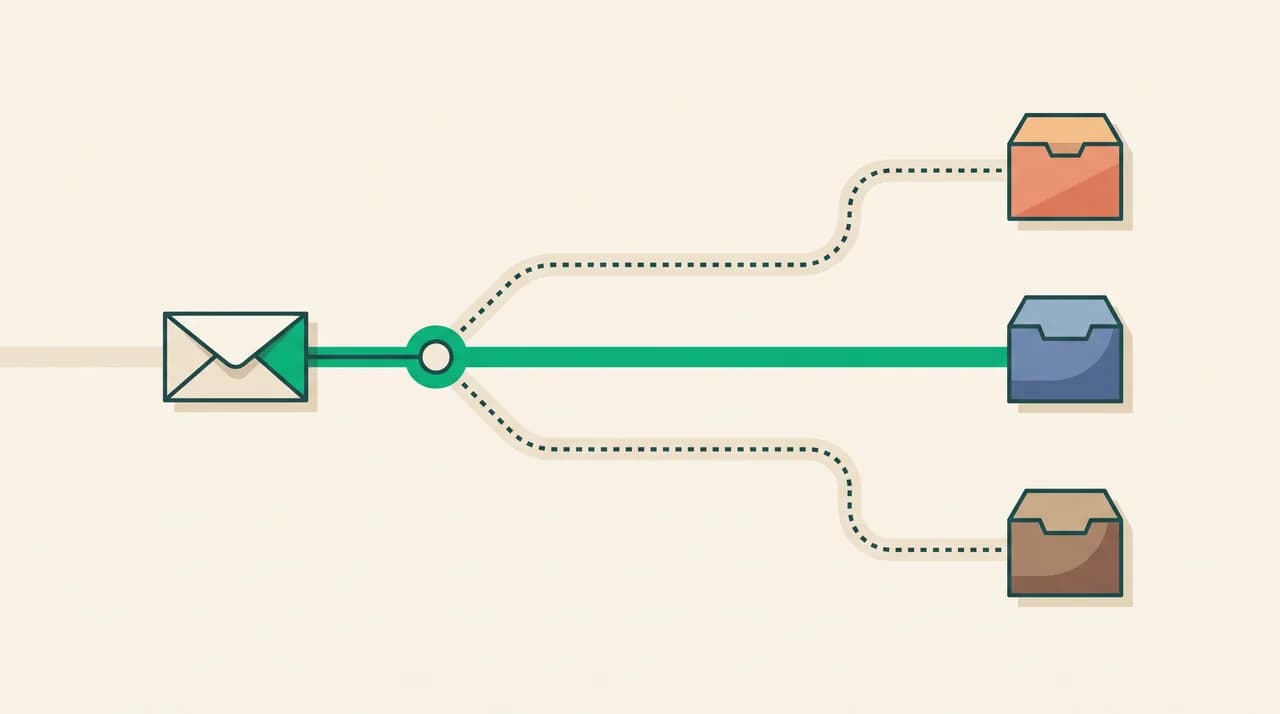
Put the three inputs together and you have the shape of every inbox-or-spam decision. Authentication clears identity, reputation supplies the sender's history, and live engagement keeps nudging the outcome message by message. The diagram shows those inputs feeding one routing decision.
Common misconceptions#
Most confusion about engagement signals comes from over-trusting the easy metrics and under-weighting the deliberate ones. These are the ones worth correcting.
- 'A high open rate proves good deliverability.' It doesn't. Google says it does not track open rates and cannot verify third-party open tracking, and an open can fire from an image proxy or a preview pane. Opens are analytics, not a reputation input.
- 'Marking a message not-spam only helps me.' It helps the sender too. Moving mail out of spam is an explicit 'this is wanted' signal, and repeated positive placement by real recipients is exactly what rebuilds a sender's reputation.
- 'One reply fixes a bad reputation.' No single action overrides a domain's history. Reputation is a pattern across many recipients over time, not a switch one person flips.
- 'Deleting is as bad as reporting spam.' Deleting unread is a mild negative; a spam complaint is the strongest negative there is. Different buttons, very different weight.
- 'Engagement signals only matter to marketers.' They shape your personal inbox too — Gmail's importance markers run on your own opens, replies and archives, deciding what gets flagged as important for you.
How this shows up in AI Emaily#
Where does a mail client fit? Not on the sending side. AI Emaily is not an email service provider, a deliverability tester, or a DMARC monitor, and installing it does not change how Gmail, Yahoo or Outlook score the mail you send. If your outbound is landing in spam, the fix lives with your sending tool and the reputation your domain earns with other providers — not with us, and we would rather say that plainly than imply a fix we do not provide.
The adjacent job we do is on the receiving side, and it runs on the same signals this glossary describes. AI Emaily reads engagement and authentication cues on the mail arriving in your own inbox — how a sender's messages have been treated, whether they pass SPF, DKIM and DMARC alignment, whether the pattern looks like unsolicited outreach — to sort real mail from spam and cold pitches without you hand-training a filter, with approve-before-send, undo and an audit trail on anything it does. We build AI Emaily. It runs on Gmail, Outlook and standard IMAP, and comes with a 7-day free trial on the Pro and Autopilot plans — there is no permanent free tier, and your card is not charged if you cancel before day seven.
Frequently asked
See it in AI Emaily
Keep reading
Sources

Written by
Nafiul HasanNafiul Hasan is an entrepreneur and AI automation system builder with 10+ years of experience turning messy, manual workflows into reliable automated systems. He designs and ships AI enterprise solutions end-to-end — the agent logic, the data plumbing, and the product people actually use — and founded AI Emaily to give busy professionals their attention back. He writes here from the builder's seat: what works, what breaks, and how to put AI to work without giving up control.