Client-Only Rules vs Server-Side Rules in Outlook

The short answer
A server-side rule runs on Microsoft's Exchange servers, so it keeps working on every device even if your computer is off. A client-only rule needs classic Outlook open and connected on the specific machine that created it, because it depends on an action — like playing a sound or filing mail into a local PST — only the desktop app can perform.
Client-only rules in Outlook need your PC on; server-side rules run in the mailbox itself. Which actions force the split, and how to fix it.
On this page
- 01Client-only rules vs server-side rules, at a glance
- 02Which actions and conditions force a rule to become client-only
- 03Where client-only rules win
- 04Where server-side rules win
- 05How to redesign a rule so it runs on the server
- 06What it actually costs to get server-side rules
- 07Who each is genuinely for
- 08A third option, honestly: skip the rule engine entirely
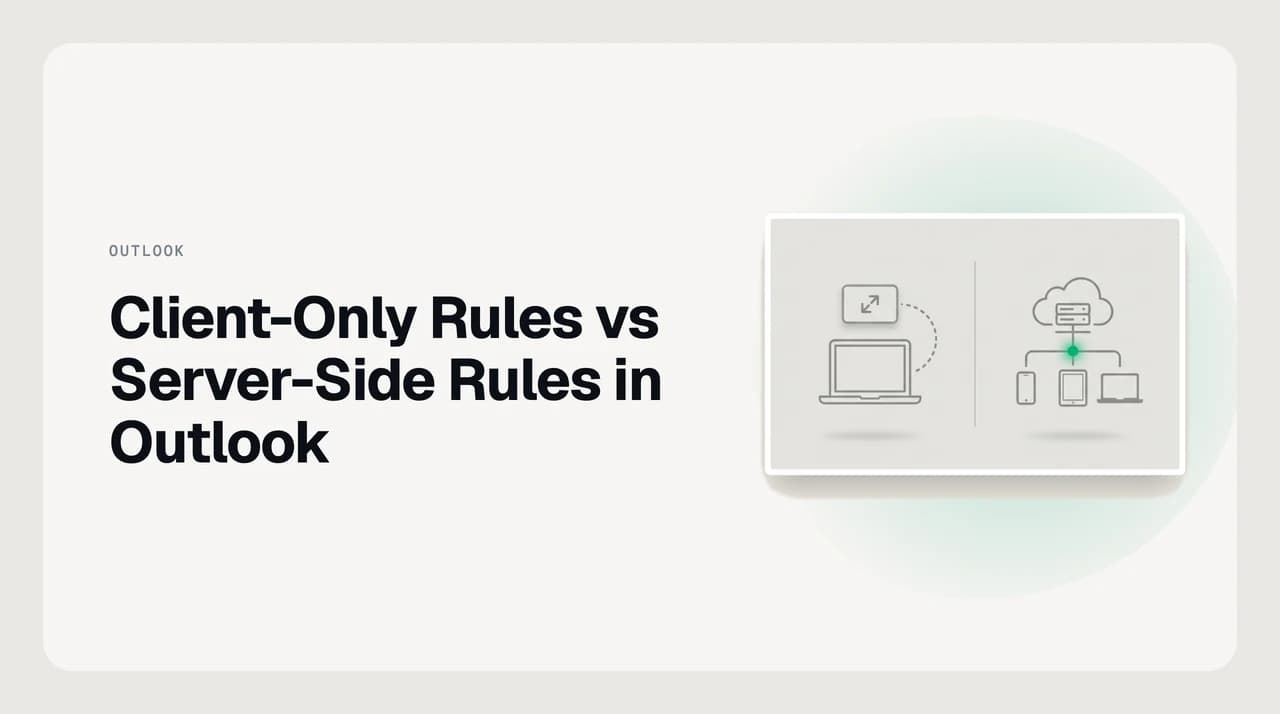
The short version: a server-side rule lives in your mailbox and runs on Microsoft's Exchange servers, so it fires whether or not any computer is turned on. A client-only rule lives — or at least executes — inside one specific copy of classic Outlook, and stops firing the moment that Outlook is closed.
Outlook decides which kind a rule is automatically, based on what the rule does, not what you meant it to do. Every client-only rule started as a normal rule that used one action or condition the Exchange server can't evaluate itself. The fix is almost always to find that one line and replace it, not to rebuild the whole rule.
This post covers the actions that force the client-only label, how to tell which kind you already have, and how to redesign a rule so it runs on the server — which is the root cause behind most "my Outlook rule stopped working" complaints.
Client-only rules vs server-side rules, at a glance#
Both kinds live inside the same Rules Wizard and look identical when you build them. The difference only shows up in where the rule actually executes, and that's what determines whether it survives a closed laptop, a new device, or a switch to new Outlook.
| Dimension | Client-only rule | Server-side rule |
|---|---|---|
| Runs with your PC off or Outlook closed | No — needs classic Outlook open on the machine that owns it | Yes — runs on Exchange even if every device is off |
| Same result on phone, web, and other PCs | No — only the one Outlook install that created it | Yes — one copy, stored in the mailbox, same everywhere |
| Where the rule actually lives | Tied to that local Outlook profile | In the mailbox, on Microsoft's Exchange servers |
| Works in new Outlook, Outlook on the web, Outlook.com | No — those apps only run server-side rules | Yes |
| Account types it applies to | Any — including POP3 and IMAP | Exchange or Microsoft 365 mailboxes only |
| Typical cause | One condition or action the server can't evaluate | Only standard conditions/actions the Exchange rule engine supports |
Which actions and conditions force a rule to become client-only#
Most rules that get marked client-only aren't unusual — they're a normal filing rule plus one extra step that happens to require Outlook to be the thing running. Move, delete, forward and mark-as-read are all standard mailbox operations Exchange executes directly, on its own.
The line that breaks it is almost always one of these: something that has to happen on your physical machine at the moment mail arrives, not to the message itself.
| Action or condition | Runs server-side? | Why |
|---|---|---|
| Move to a folder, delete, forward, mark as read | Yes | Standard mailbox operations the Exchange rule engine executes directly |
| Play a sound | No | Requires the desktop app to produce audio on your machine the instant mail arrives |
| Show a desktop alert or pop-up | No | The alert renders inside the Outlook window, so Outlook has to be the thing running |
| Move or copy mail into a local PST file | No | A PST lives on disk, outside the Exchange mailbox the server can reach |
| Run a script or start another application | No | Local automation the server has no path or permission to execute |
| Print a copy of the message | No | Sends the job to a printer attached to that specific PC |
Outlook already tells you
One account type skips the whole question: POP3 and IMAP accounts have no Exchange mailbox behind them, so every rule on those accounts is client-only by definition — even a plain "move to folder" rule needs Outlook open, because there's no server-side rule engine to hand it to.

Where client-only rules win#
Client-only rules aren't a bug or a downgrade — they're the only way to reach a few genuinely local actions, and they cost nothing extra because Outlook itself is doing the work.
- The action itself: a sound, a printed copy, a desktop pop-up, a local script — none of that has a server-side equivalent, because it's a job for the machine in front of you, not the mailbox.
- No mailbox requirement: they run identically on a free POP or IMAP account as on a full Exchange seat, since nothing about them depends on Exchange.
- Easiest to debug live: you can sit at the PC, send yourself a test message, and watch the rule fire in real time.
The one place classic Outlook wins outright
Where server-side rules win#
For everything that isn't a genuinely local action, server-side is the better design, because the rule stops depending on a specific piece of hardware being on.
- Keeps running with the PC off, asleep, or three time zones away on vacation.
- Produces the same result on your phone, on the web, and on every other PC signed into the mailbox — because there's only one copy, and it lives in the mailbox.
- Survives a reinstalled Outlook profile or a replacement laptop, since nothing about the rule was ever stored on the old machine.
- Doesn't silently stop working the day you move to new Outlook or start using Outlook on the web — both only run server-side rules at all.
How to redesign a rule so it runs on the server#
- 1
Open the rule and check the label
In classic Outlook, go to File > Manage Rules & Alerts. Any rule the server can't run shows "(client-only)" right after its name — that's your starting list.
- 2
Find the specific line tripping it
Edit the rule and compare each condition and action against the table above. Usually it's one line — a sound, an alert, a PST destination, a script — not the whole rule.
- 3
Swap it for a server-safe equivalent
Replace "play a sound" with checking the folder manually, replace "move to a local PST" with "move to a folder" inside the mailbox itself, and drop any custom script or add-in action.
- 4
Recreate rather than edit if the tag sticks
Some rules keep the client-only flag even after the offending line is removed. Delete the rule and rebuild it from scratch using only server-supported conditions and actions.
- 5
Confirm it actually moved
Reopen Manage Rules & Alerts and check the tag is gone. Then close Outlook entirely and send a test message from a different account — if it still files correctly, it's server-side.
What it actually costs to get server-side rules#
Server-side rule support isn't a paid add-on you switch on — it's what you already have the moment your mailbox has a real Exchange back end behind it. A Microsoft 365 Personal, Family or Business plan, and a plain free Outlook.com or Hotmail address, all run on that back end, which is why rules built in Outlook on the web are server-side rules by default.
What actually blocks server-side rules is the account type, not the subscription tier: connect a POP3 mailbox, or an IMAP account from a provider with no Exchange back end, into classic Outlook, and every rule on it stays client-only regardless of how much you're paying Microsoft for everything else.
So the real question to check before you redesign anything is which kind of account the rule is attached to, not which plan is on the invoice. Microsoft's own plan names and included features change; confirm the current Microsoft 365 and Exchange Online tiers on Microsoft's pricing pages before you commit a team to one.
Check the account type first
Who each is genuinely for#
Neither kind is objectively better — they answer different questions, and most inboxes end up using both.
- Client-only fits a single-device user whose one extra step is genuinely local — a sound alert for a VIP sender while you're at your desk — or anyone whose account is POP/IMAP and has no Exchange mailbox to move the rule into anyway.
- Server-side fits anyone who checks mail on a phone, anyone with more than one PC, anyone who wants a rule that keeps working the week they're out of office, and any admin who needs a rule to survive a machine getting wiped and reissued.
- Neither is the right layer for org-wide policy — routing every invoice to accounting no matter who receives it belongs in a transport (mail flow) rule set by an admin in the Exchange admin center, which runs before the message reaches any individual mailbox at all.
A third option, honestly: skip the rule engine entirely#
Both kinds of Outlook rule are static: they match conditions you wrote down in advance, and they don't get better at telling a real client from a newsletter mid-thread. When your workflow changes, the fix on either kind is the same — open the rule and edit it by hand.
AI Emaily approaches the same underlying job — an inbox that doesn't need you to babysit it — as a running agent instead of a rule you maintain. It triages, files and drafts across Gmail, Outlook and IMAP accounts from one place, in the cloud, so it behaves the same whether your laptop is open or closed. That's the same property that makes server-side rules useful, without a rules wizard to redesign every time a sender pattern changes. We build AI Emaily, and this is exactly the workflow it's built to run continuously rather than something you configure once and hope stays accurate.
It doesn't replace the one thing classic Outlook still does that nothing cloud-based can: a client-only action executes on your physical machine, and that includes AI Emaily — no cloud tool can play a sound through your speakers or launch a local script the instant mail lands. If that's the specific job, keep the client-only rule; it's free, and it's the only tool built for it. And if the real requirement is org-wide mail-flow enforcement, that's an admin transport rule, not an inbox agent, on either side.
Frequently asked
See it in AI Emaily
Keep reading
Sources

Written by
Nafiul HasanNafiul Hasan is an entrepreneur and AI automation system builder with 10+ years of experience turning messy, manual workflows into reliable automated systems. He designs and ships AI enterprise solutions end-to-end — the agent logic, the data plumbing, and the product people actually use — and founded AI Emaily to give busy professionals their attention back. He writes here from the builder's seat: what works, what breaks, and how to put AI to work without giving up control.