What Counts as an Unsolicited Email (and What Doesn't)

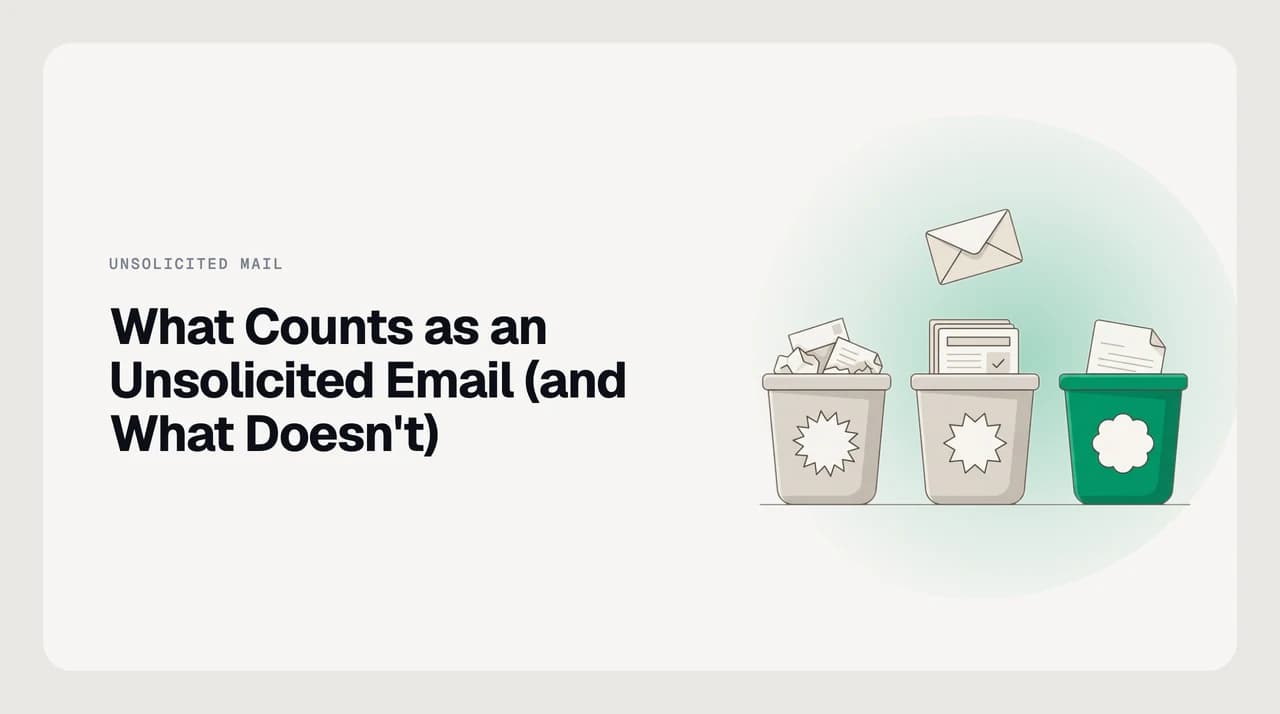
The short answer
An unsolicited email is any message you did not ask to receive. It is not automatically spam. Spam is a narrower category — either mail that violates CAN-SPAM rules or messages your provider flags as abusive. A cold sales email can be unsolicited, legally compliant, and not spam at the same time.
An unsolicited email is any message you didn't ask for — but not every unsolicited email is spam. Here's how to tell them apart.
On this page
An unsolicited email is any message you did not ask to receive. The sender contacted you without your prior consent or request — that definition covers everything from a first-contact sales pitch to a newsletter you cannot remember signing up for. What it does not tell you is whether the mail is spam, whether the sender broke any rule, or what the right inbox action is.
Unsolicited and spam describe different things, and conflating them produces the wrong response. Hitting report spam on a legally compliant cold email distorts your mail provider's filters and can hurt the sender's delivery reputation for everyone they reach. Understanding where unsolicited email ends and spam begins gives you a framework for sorting your inbox accurately.
How Unsolicited Email Actually Works#
An email is unsolicited the moment the sender had no pre-existing permission from you. Permission here means you actively signed up, submitted your address, or directly requested contact — not that you visited a website, appeared in a public directory, or were mentioned in a mutual connection's conversation.
Your address reaches senders through more channels than most people track: a public LinkedIn profile, a company website, a conference attendee list, a data broker who scraped and resold contact records, or a colleague who forwarded your details. In every case the message arrives without your consent. That makes it unsolicited. It does not make it illegal.
Under the US CAN-SPAM Act, commercial senders may contact US recipients without prior opt-in, provided they use honest header information, an honest subject line, identify the message as commercial, include a physical postal address, and honor unsubscribe requests within ten business days. A cold sales email that meets those conditions is unsolicited and fully legal. CAN-SPAM's mechanism is opt-out, not opt-in.
CAN-SPAM vs. GDPR
Why the Distinction Matters#
Mislabeling unsolicited mail as spam has two real costs — one to the ecosystem, one to you.
The ecosystem cost: spam reports are signals that mail providers aggregate across all users. When you report a legally compliant cold email as spam, that signal contributes to the sender's complaint rate. High complaint rates throttle or block delivery for everyone that sender reaches — including people who want to hear from them.
The personal cost: if you route all unsolicited mail to spam without reading it, you will miss things that matter. A recruiter who found you through a shared contact, a conference organizer with a speaking slot, a prospective partner who tried the right channel — these arrive as technically unsolicited messages worth reading.
The more useful question is not 'did I ask for this?' but 'what kind of mail is this, and what does it want?' That question separates four categories that require different handling.
- Solicited mail you expect: replies, confirmations, newsletters you actively read.
- Unsolicited but legitimate outreach: genuine first-contact messages worth evaluating even though you didn't invite them.
- Unsolicited, compliant but not relevant: cold sales following the rules but not useful to you — use the unsubscribe link, not the spam button.
- Actual spam: deceptive headers, phishing attempts, malware, or bulk mail with no opt-out — report and block.
Unsolicited, Spam, and Unwanted — How They Overlap#
These three terms are used interchangeably in everyday conversation but describe distinct categories. The table below maps the key dimensions so you can place any incoming message correctly before deciding what to do with it.
| Dimension | Unsolicited email | Spam | Unwanted email |
|---|---|---|---|
| You requested it? | No | No — and typically deceptive | Varies — often yes, once |
| Violates CAN-SPAM? | Not necessarily | Yes — false headers, no opt-out, or both | Not necessarily |
| Provider filters catch it? | Not automatically | Often — abuse patterns are identifiable | Sometimes — if complaint rates are high |
| Right inbox action | Read and decide; unsubscribe if not relevant | Report; do not click links | Unsubscribe or create a filter |
| Example | Cold sales pitch with working unsubscribe link | Phishing email with spoofed sender name | Newsletter you forgot you signed up for |
Common Misconceptions About Unsolicited Email#
Getting these wrong leads to over-reporting (damaging sender ecosystems) or under-filtering (leaving genuinely harmful mail in the inbox).
- 1
"All cold email is spam."
False under US law. CAN-SPAM explicitly permits commercial email without prior consent provided the sender follows the disclosure and opt-out requirements. A first-contact B2B sales email from a real company with honest headers is unsolicited — it is not spam.
- 2
"If I didn't give them my address, it is illegal."
Not in the US. Publicly available addresses — on LinkedIn, a company website, a conference directory — can be contacted legally. The law governs how you contact someone, not only whether you were given their address directly.
- 3
"Reporting cold email as spam only affects me."
False. Spam reports are aggregated signals. High complaint rates against a domain or sending infrastructure can throttle delivery for all that sender's recipients — including people who asked to receive their mail.
- 4
"Unsubscribing makes it worse."
Mostly a myth for legitimate senders. CAN-SPAM requires compliant senders to honor opt-out requests within ten business days and prohibits charging for the opt-out. For clear phishing or spoofed senders with no real company behind them, do not click any link. For identifiable commercial senders, the unsubscribe mechanism is the correct tool.
- 5
"A newsletter I subscribed to isn't unsolicited."
Correct — but it can still become unwanted. Solicited mail you no longer want and unsolicited mail are different categories with different solutions: for forgotten subscriptions, unsubscribe; for genuinely unsolicited mail, assess whether it is legitimate outreach or spam before deciding.
How AI Emaily Handles Unsolicited Outreach#
Most inbox tools treat unsolicited as a binary: let everything through or route it all to spam. That approach merges two distinct categories — legitimate but unwanted commercial outreach and genuinely abusive mail — and the correct response to each is different.
AI Emaily's cold-email filter adds a separate layer between your inbox and your spam folder. It identifies unsolicited commercial outreach — first-contact sales, prospecting sequences, commercial offers you never subscribed to — and routes it to a dedicated tray rather than mixing it with phishing and malware. What reaches your inbox has cleared the bar; what doesn't is still visible when you want it, without triggering a spam report against a sender who may be following every rule. The filter works on sender behavior and message structure, not just whether the address is recognized. We build AI Emaily.
Frequently asked
See it in AI Emaily
Keep reading
Sources

Written by
Nafiul HasanNafiul Hasan is an entrepreneur and AI automation system builder with 10+ years of experience turning messy, manual workflows into reliable automated systems. He designs and ships AI enterprise solutions end-to-end — the agent logic, the data plumbing, and the product people actually use — and founded AI Emaily to give busy professionals their attention back. He writes here from the builder's seat: what works, what breaks, and how to put AI to work without giving up control.