Why Am I Getting So Many Cold Sales Emails All of a Sudden?

The short answer
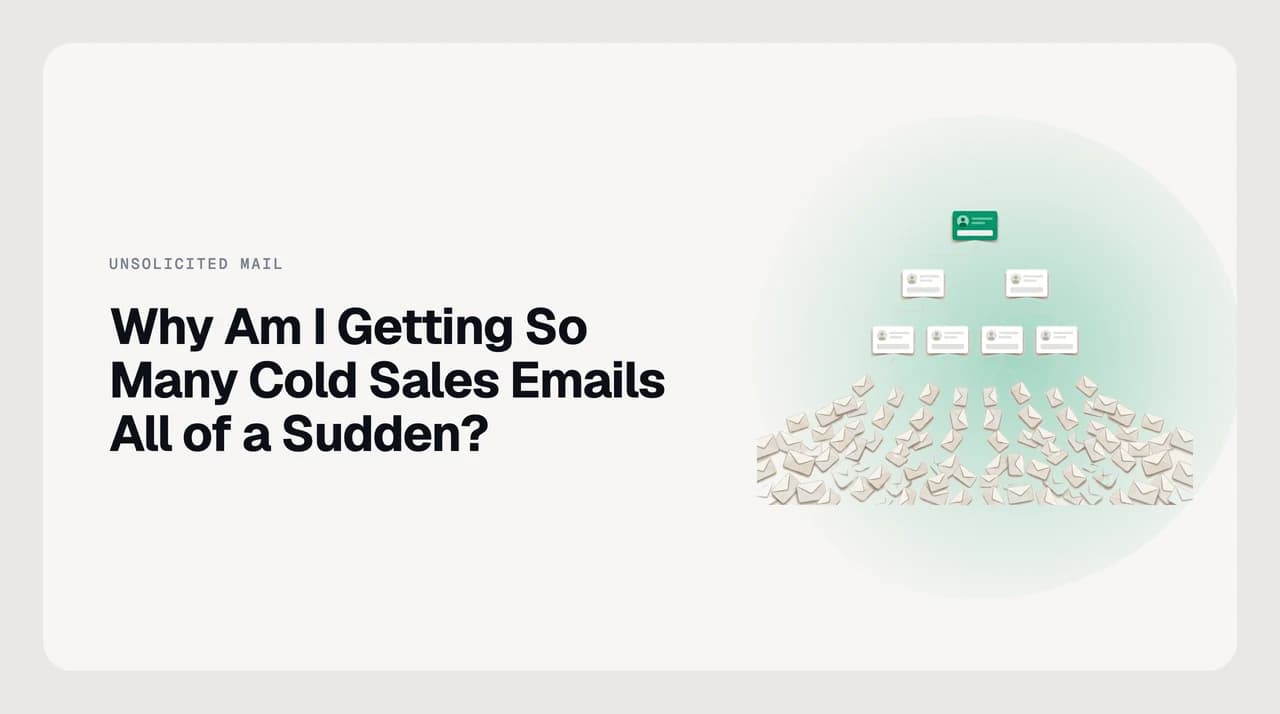
Your work email ended up in a contact database maintained by a data provider — companies like Apollo or ZoomInfo aggregate professional profiles from public sources and crowdsourced contributions. Sales teams buy filtered lists and run automated sequences against them. One appearance in a database typically spreads to others, which is why volume tends to spike suddenly rather than gradually.
Your work email is in contact databases sold to sales teams. Learn how addresses get there, why volume spikes, and how to reduce it.
On this page
If your inbox has recently started filling with pitches from software vendors, staffing platforms, and tools you never contacted, you are not imagining a surge. So many cold sales emails arrive because your work address ended up in a contact database, and one or more sales teams pulled it this week. The volume can escalate once that happens, and understanding the supply chain behind it is the first step toward doing anything useful about it.
How Does a Sales Team Find Your Work Email Address?#
B2B contact data providers — companies such as Apollo, ZoomInfo, Lusha, and Cognism — build searchable databases of professional contact information. Their sources include public-facing content: LinkedIn profiles, company websites, press releases, conference attendee listings, and job postings that name hiring managers. Some platforms add a crowdsourcing layer, where their own users contribute contacts from their CRM or inbox in exchange for platform credits. Apollo, for instance, describes this as a community-based approach to data collection. A colleague or client who uses one of these tools may have contributed your details without realising it.
A sales team logs in, applies filters for job title, company size, industry, and geography, and exports a list of hundreds or thousands of matching contacts in a few minutes. They did not search for you individually. Your professional profile matched the filter criteria they set, and you appeared alongside everyone else who did.
Email enrichment extends this further. If a prospecting team has your name and employer but not your address, an enrichment service can often derive and verify it by testing common email formats against your domain. Your address may never have appeared on a public page for the enrichment to succeed — your name and employer, both commonly public, can be enough.
What Happens After They Have Your Address?#
Sales sequencer tools — such as the built-in sequences in Apollo, or dedicated platforms like Outreach and Instantly — let a team upload an exported list and run a multi-step campaign automatically. A typical sequence runs three to five emails spaced over two weeks: an opening pitch, a follow-up if you have not replied, and a closing message asking whether to end the outreach. The campaign runs without a human writing each individual message at send time.
Artificial intelligence has changed the economics of personalisation at this scale. Earlier sequences used simple merge tags — your first name, your company name. Newer tools generate an AI-written opening line drawn from your LinkedIn headline, a post you published, or a role your company is currently hiring for. Each email reads as individually composed, but the content is generated from your public profile data and applied to a list of hundreds of contacts at once. This is why a cold pitch can reference your exact job title and still be one of thousands sent that morning.
When a sequence ends and you have not replied, your record stays in the database marked as unresponsive. The next quarter, another team at the same company — or a different company using the same provider — may pull the same filters and start a new sequence. There is no coordination between senders on who has already contacted you.
Why Does the Volume Escalate Over Time?#
A single database appearance rarely stays confined to one vendor. Data providers license records to each other, resell enriched lists, and share contact data through API integrations with CRM and marketing platforms. Once your address is confirmed as deliverable and associated with a business title, it becomes more commercially valuable and circulates more widely across the ecosystem.
Certain events accelerate this. Updating a job title on LinkedIn creates a fresh data point for automated scrapers. A press mention, a conference appearance, or a company website that lists a team page with professional contact details all generate new signals that feed back into the data cycle. Signing up for a free trial on a B2B software platform and accepting marketing communications can also add you to that vendor's list, which may itself be shared or resold.
The result is nonlinear. Two or three emails per week can become several per day within months — not because any single sender intensifies, but because the number of teams with access to a verified, active professional address accumulates across providers. You are not being targeted specifically; you are being reached because verified deliverable contacts in your role are commercially useful.
How B2B Cold Email Differs From Other Unwanted Mail#
Not all unwanted email arrives the same way or carries the same legal weight. The differences matter when you are deciding what to do about each type.
| Type | How the sender got your address | Legal basis (US) | Legal basis (EU/UK) |
|---|---|---|---|
| B2B cold outreach | Licensed or enriched from a contact data provider | CAN-SPAM: legal if sender is identified, opt-out is offered and honoured within ten business days | GDPR: sender must pass a legitimate-interest test weighing their commercial interest against your privacy rights |
| Consumer spam | Unknown scraping, breach data, or purchased illegal lists | CAN-SPAM prohibits deceptive headers and requires a working opt-out; illegal lists violate the act | ePrivacy Directive: prior consent required for unsolicited commercial email to consumers |
| Newsletter from a vendor | Website sign-up or gated-content download | Opt-in collected at the point of sign-up | GDPR: consent-based; must be freely given, specific, and easy to withdraw |
| Promotional from a past vendor | Your purchase or account history with that company | CAN-SPAM: implicit soft opt-in from the commercial relationship | ePrivacy: existing-customer exception permits outreach for similar products |
CAN-SPAM and prior consent
Common Misconceptions About Cold Sales Email#
Several widely held beliefs about cold outreach lead people toward responses that do not help or that make things worse.
- Unsubscribing removes you from all lists. It removes you from that sender's list only. Your record stays in the underlying contact database, and other teams querying the same provider can still reach you. For messages from recognisable companies, unsubscribing is still worthwhile — CAN-SPAM requires them to honour it within ten business days. For suspicious-looking messages, use a spam report rather than clicking any link.
- My address was leaked in a data breach. Possible, but most B2B cold outreach originates from legal contact data providers, not breach data. These companies depend on legally defensible sourcing as their core business model; breach data is a separate problem with different characteristics.
- The sender personally researched me. Sales teams set filter criteria and launch sequences. In most cases, no individual read your profile. Your job title matched a filter, and your name appeared in an exported list alongside everyone else who did.
- If an email looks personalised, a human wrote it. AI tools generate personalised opening lines from your public profile data — your LinkedIn headline, your company, a recent job posting — and apply them to lists at scale. An email that mentions your exact title and a fact from your public profile was almost certainly not composed by a human reading your page.
- Cold email is illegal. In the US, B2B cold email that complies with CAN-SPAM is legal. In the EU and UK, the legal position under GDPR depends on whether the sender can demonstrate a legitimate interest that outweighs your rights as a data subject — an area where enforcement continues to develop and varies by country.
How AI Emaily Handles Cold Outreach in Your Inbox#
The supply chain above — data providers, enrichment tools, sequencer platforms that rotate sending domains between campaigns — is exactly what AI Emaily's cold-email filter was built to triage. Blocking a single sender address does not hold when a sequencer rotates to a new sending domain mid-campaign; the filter identifies sender behaviour and domain patterns so a rotation does not reset the triage decision. Unsolicited outreach lands in a dedicated folder by default, visible and reviewable with one click, without competing with the messages that need a real reply. We build AI Emaily, and the cold-email filter ships with every plan.
Frequently asked
See it in AI Emaily
Keep reading
Sources

Written by
Nafiul HasanNafiul Hasan is an entrepreneur and AI automation system builder with 10+ years of experience turning messy, manual workflows into reliable automated systems. He designs and ships AI enterprise solutions end-to-end — the agent logic, the data plumbing, and the product people actually use — and founded AI Emaily to give busy professionals their attention back. He writes here from the builder's seat: what works, what breaks, and how to put AI to work without giving up control.