What Is a Disposable Email Address? How Burner Inboxes Work


The short answer
A disposable email address is a temporary or throwaway address you use instead of your real one — usually to sign up for a site or trial without exposing your inbox. An alias is a permanent forwarding address you control. Disposables expire or delete; aliases forward indefinitely.
A disposable email address is a temporary inbox or alias that hides your real address. Covers throwaway inboxes, relay aliases, and plus tags.
On this page
- 01How does a disposable email address work?
- 02Why does hiding your real address matter?
- 03Disposable inbox, relay alias, or plus tag: what is the difference?
- 04Common misconceptions about burner email addresses
- 05Do sites block disposable email addresses?
- 06How AI Emaily handles the inbox your alias protects
A disposable email address is a temporary or throwaway address you give to a website, app, or service instead of your real inbox. The term covers three architecturally different approaches: a public throwaway inbox that anyone can read, a private relay alias that forwards mail to your real mailbox, and a plus tag that extends your own address. All three look like a real email address to the service receiving them.
The word disposable gets used loosely, which is why many people treat these three types as interchangeable. They are not. A public throwaway inbox offers anonymity but zero continuity. A relay alias gives you privacy and control — you can receive, filter, and retire it. A plus tag is a routing convention built into most providers, not a real alias. Understanding the difference determines whether the protection you want actually holds up.
How does a disposable email address work?#
The simplest type is a public throwaway inbox. You visit a service that generates an address on demand, use it to confirm a signup or receive a download link, and read the mail in a shared public queue without creating an account. The address is typically short-lived — anywhere from minutes to a few hours — and is not private: anyone who types or guesses the same address can read the same mail. It protects your real identity from the service you signed up with, but not from anyone else who knows the address.
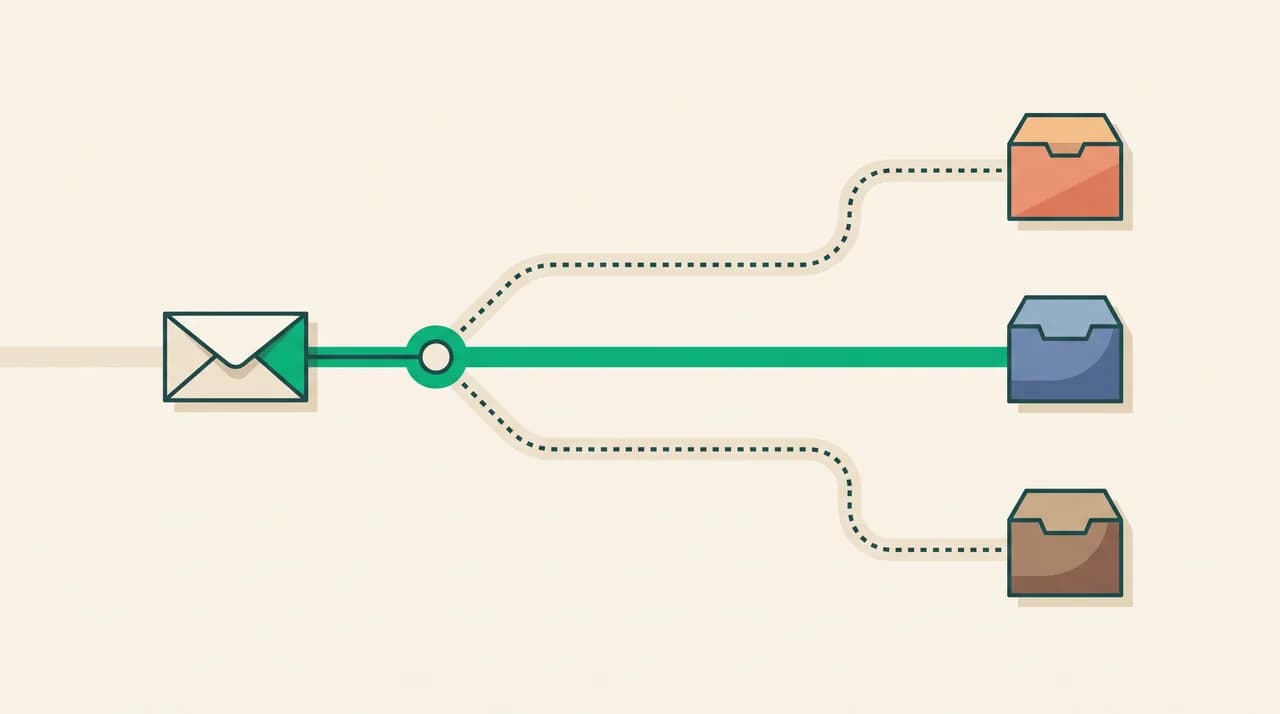
A relay alias works differently. You give a service your alias address — a randomly generated address from a service like Apple Hide My Email, Fastmail masked email, SimpleLogin, or Addy.io — and every message sent to that alias is forwarded to your real inbox. You receive and reply normally; the original sender only ever sees the alias. If the alias starts receiving spam, you delete it and the forwarding stops. Your real address is never exposed in the headers the sender sees.
Plus addressing — defined in RFC 5233, the Sieve subaddress extension — appends a tag to your existing local part. The format is [email protected]; the tag is stripped by the receiving server and the mail lands in your normal inbox. It is not a true alias: your base address appears in routing headers and is trivially recoverable by stripping the plus sign. Most bulk-email platforms do exactly that before constructing their sender lists, which limits plus tags as a blocking or privacy tool.
Why does hiding your real address matter?#
Every time you give your real address to a service you do not fully trust, you accept three risks: spam if the service sells or leaks its list, tracking via personalized links in mail you receive, and exposure if the service suffers a data breach that surfaces your address to harvesters. A throwaway or alias address eliminates the first and third risks — spam reaches the alias, and a breach exposes the alias, not your real identity.
The blast-radius effect compounds over years. A single breach at a newsletter you signed up for years ago can feed targeted phishing into your primary inbox for the rest of the decade. An alias address contains the damage — you retire the alias and the flow stops, while your real address stays clean. Public throwaway inboxes offer coarser protection: the flow is anonymous but the inbox is shared and expires, making it unsuitable for anything you need to retrieve more than once.
Disposable inbox, relay alias, or plus tag: what is the difference?#
| Type | Forwards to you | Revocable | Hides real address | Private | Lifespan | Best for |
|---|---|---|---|---|---|---|
| Public throwaway inbox | No | N/A | Yes | No — shared public queue | Minutes to hours | One-off confirmations you will never need again |
| Relay alias (masked email) | Yes | Yes — delete the alias | Yes | Yes — only you receive it | Indefinite, until deleted | Long-term privacy; newsletter and trial signups |
| Plus tag ([email protected]) | Yes — same inbox | Limited — filter rule only | No — base address visible in headers | Yes | Indefinite | Sorting mail by source; not a true privacy tool |
Plus tags do not hide your real address
Common misconceptions about burner email addresses#
The biggest misconception is that a disposable address makes you anonymous. It does not. The service you sign up with does not see your real email address, but it still sees your IP address, browser fingerprint, and any other account information you provide. A throwaway email is one layer of separation, not full anonymity.
A second misconception is that sites never detect or block disposable addresses. Many do. Consumer services and enterprise software vendors maintain blocklists of known public throwaway domains and query dedicated blocklist APIs at signup. A relay alias on a reputable domain typically passes these checks because its domain does not appear on throwaway blocklists — which is one practical reason relay aliases are more useful than public throwaway inboxes for services you actually intend to use long-term.
A third misconception is that you can reply from a public throwaway inbox. You cannot. Public inboxes are receive-only and shared. Only relay aliases support two-way communication: some services let you reply from the alias address so your real address never appears in a reply thread, which is the behavior you need for ongoing correspondence rather than a single confirmation.
Do sites block disposable email addresses?#
Yes, and the practice is widespread on services that want to prevent trial abuse or reduce spam complaints. Blocklists of known public throwaway domains — including many of the well-known providers in this space — are updated frequently and queried at signup by many consumer and business platforms. Attempting to register with a public throwaway address on a major service will often return a rejection telling you to use a valid email address.
Relay aliases on reputable domains generally pass these checks because their sending domains are not flagged as disposable. If you need an alias for a service you actually plan to use, a relay alias from a recognized provider is more likely to be accepted. Some services additionally verify that an address can receive mail by sending a confirmation before completing signup — a step that an expired public throwaway inbox will fail. Verify whether the service you care about accepts the alias type you intend to use before you rely on it for account recovery or critical notifications.
How AI Emaily handles the inbox your alias protects#
Disposable addresses and relay aliases reduce what reaches your real inbox; they do not manage what does arrive. The mail that gets through — from services you use, clients, colleagues, and the spam that slips past your alias layer — is the job AI Emaily handles. We build AI Emaily, an AI-native email client that triages incoming mail, drafts replies in your voice using a user-set Context brain and per-client profiles, and filters cold email and spam, across Gmail, Outlook, and IMAP accounts. It is not an alias service; it starts where one stops. You can see what it does at aiemaily.com or review the plans at aiemaily.com/pricing — a 7-day free trial is included.
Frequently asked
See it in AI Emaily
Keep reading

Written by
Nafiul HasanNafiul Hasan is an entrepreneur and AI automation system builder with 10+ years of experience turning messy, manual workflows into reliable automated systems. He designs and ships AI enterprise solutions end-to-end — the agent logic, the data plumbing, and the product people actually use — and founded AI Emaily to give busy professionals their attention back. He writes here from the builder's seat: what works, what breaks, and how to put AI to work without giving up control.