Why no-reply Email Addresses Are a Bad Idea (And the Fix)

The short answer
No-reply addresses are a bad idea because they suppress the replies mailbox providers treat as positive engagement, strand people who need support, and hide inbound work instead of removing it. Use a monitored role inbox such as support@ or hello@, with a Reply-To that routes to a staffed mailbox someone actually reads.
Why not to use a no-reply email address: it kills engagement signals, breaks support, and hides work. Here's the monitored-inbox fix.
On this page
- 01What a no-reply email address is
- 02Why no-reply addresses are a bad idea
- 03Is no-reply bad for deliverability?
- 04It breaks support and ignores how people reply
- 05It hides the work — it doesn't remove it
- 06Fix 1: Send from a monitored inbox
- 07Fix 2: Point Reply-To at a real inbox
- 08Fix 3: Triage the replies so the volume stays sane
- 09How to tell which fix you need
- 10Preventing the no-reply trap
- 11Where AI Emaily fits
A no-reply email address is one that sends mail but refuses to receive it: replies bounce, or drop into a mailbox no human ever opens. Here is why not to use a no-reply email address: it saves you nothing real and costs you several things that do matter.
It quietly suppresses the engagement signals mailbox providers weigh, closes your most obvious support channel, ignores how many people still reply instead of clicking, and moves work rather than removing it. This guide explains what the address is, why it backfires on all four counts, and the monitored-reply pattern to use instead.
What a no-reply email address is#
A no-reply address usually looks like [email protected] or [email protected]. It is a From address set up so that inbound mail is either rejected or dumped into a mailbox nobody monitors.
Teams reach for it to keep automated mail — receipts, password resets, newsletters, alerts — from flooding a human inbox with out-of-office notices and one-word replies. The intent is reasonable. The method is the problem.
No standard endorses it. RFC 2142, the spec for common mailbox names, lists the role addresses an organisation is expected to run — support, info, sales, abuse, postmaster. A no-reply mailbox is not among them, because the point of a role address is that a human answers it.
Why no-reply addresses are a bad idea#
No-reply fails on four fronts, and none of them is about being polite. Each has a measurable cost, and each has a fix that is less work than it sounds.
| The cost | How it shows up | The fix |
|---|---|---|
| Lost engagement signal | Replies never happen, so a strong positive signal is never earned | Send from an address recipients can reply to |
| Broken support path | Someone replies with a real problem; it bounces or vanishes | Route replies to a staffed inbox or help desk |
| Failed expectations | People who reply instead of hunting for a link are left stranded | Keep a working reply channel, not just an unsubscribe link |
| Hidden, not reduced, work | The questions still exist; they move to slower, costlier channels | Handle the replies where they land, with triage |
Is no-reply bad for deliverability?#
Not directly. Neither Google nor Yahoo publishes a rule that penalises a no-reply From address — we checked both sender-guideline pages in August 2026, and neither mentions no-reply at all. So the honest answer is: there is no named penalty.
The damage is indirect. Mailbox providers weigh how recipients engage, and a reply is one of the strongest positive signals there is; a no-reply address forecloses it entirely. Worse, when someone can't reply and can't easily unsubscribe, the next-easiest button is report spam.
That signal does hurt. Google's guidelines ask senders to keep spam-complaint rates below 0.10% and to never reach 0.30%. A no-reply address that frustrates people nudges them toward the one action that damages your sending reputation most.
The reply button is a pressure valve
It breaks support and ignores how people reply#
For a lot of recipients, replying is the support channel. They don't scan the footer for a help link — they hit reply and type their problem. A no-reply address turns that instinct into a bounce, often with a cryptic error that makes the whole message read as if it was never genuine.
That fails the people least able to route around it: someone using a screen reader who has already found the reply action, someone on a phone where the unsubscribe link is a hard-to-tap sliver, an older recipient whose whole mental model of email is 'reply'. Meeting people where they already are is the accessible default, and a monitored reply address is how you meet it.
It hides the work — it doesn't remove it#
The promise of no-reply is less inbox load. But the questions people would have replied with do not evaporate. They resurface as support tickets, replies to your sales team, and public complaints — channels that are slower and more expensive than a reply would have been.
You did not cut the work. You moved it somewhere with worse tools and a worse paper trail, and you added the cost of the person who tried to reply first and got a bounce. That is why the fix below is about routing replies, not silencing them.
Fix 1: Send from a monitored inbox#
- 1
Pick a role mailbox a human owns
support@, hello@ or help@ — an address mapped to a real, monitored mailbox, not an alias that discards mail. The RFC 2142 role names are a safe default.
- 2
Set it as the From address
In your sending platform or app, change the From on the mail stream from noreply@ to the monitored address. Send yourself a test and reply to it.
- 3
Confirm the reply lands and is stored
The reply should arrive in a mailbox someone opens, and stay there. If it bounces or auto-deletes, you have swapped one black hole for another.
- 4
Give the inbox an owner and an SLA
Assign a person or rotation and a target response time. A monitored inbox with no owner drifts back into an unmonitored one within a month.
Fix 2: Point Reply-To at a real inbox#
Some transactional mail genuinely needs a fixed system From — password resets and receipts often send from infrastructure you can't repoint. You do not have to make that address a dead end. Add a Reply-To header instead.
- 1
Keep the system From, add a Reply-To
Leave notifications@ or the system sender as the From if your infrastructure needs it, but set a Reply-To header pointing at a staffed inbox.
- 2
Route the Reply-To to a shared inbox or help desk
Point it at support@ or a help-desk address that has an owner, so a reply becomes a ticket instead of a bounce.
- 3
Test with a real reply
Reply to an actual send and confirm it opens a ticket or lands in the shared inbox — and that someone is assigned to answer it.
Fix 3: Triage the replies so the volume stays sane#
The real objection to monitored inboxes is volume — nobody wants a person reading every out-of-office notice. That is a triage problem, not a reason to close the channel.
- 1
Auto-acknowledge, then route
Send a short auto-reply confirming receipt and an expected response time, then route each message by rule to the right queue.
- 2
Filter machines from humans
Rules that drop out-of-office notices, bounces and auto-generated mail keep the real replies visible. Mark your own automated mail with an Auto-Submitted: auto-generated header so it does not trigger reply loops.
- 3
Template the repeat questions
Most replies to automated mail are a handful of questions. Saved replies turn a 200-message queue into a few minutes of triage.
- 4
Set and publish an SLA
A response-time target makes a monitored inbox a real channel rather than a slower black hole.
How to tell which fix you need#
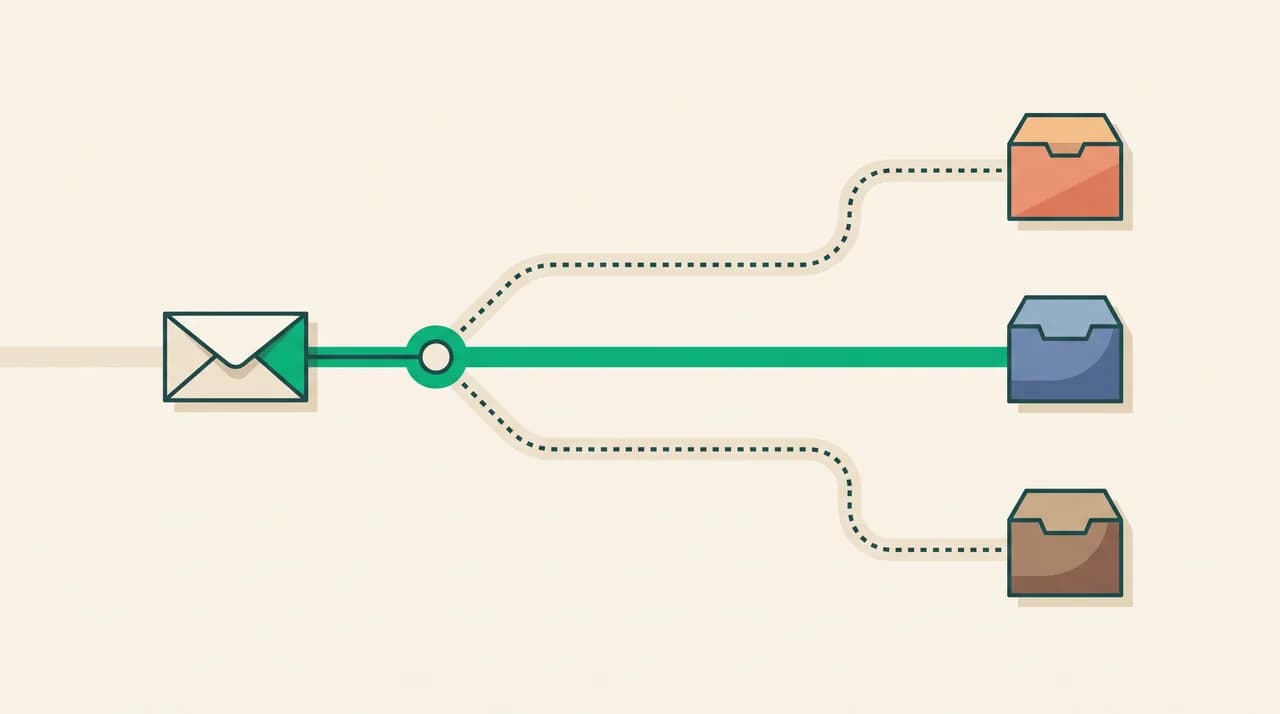
Pick by the kind of mail you are sending and where the friction actually is. Most teams end up using two of the three together.
| Your situation | Start with |
|---|---|
| Marketing or newsletter mail | Fix 1 — a monitored role From address (you already need one-click unsubscribe here) |
| Transactional mail where the From must stay systemic | Fix 2 — a Reply-To pointing at a staffed inbox |
| Any stream where reply volume is the real fear | Fix 3 — triage layered on top of Fix 1 or Fix 2 |
Preventing the no-reply trap#
- Default every new automated stream to a monitored role address from day one — migrating off no-reply later is far more work.
- Keep a working opt-out regardless. Google and Yahoo require one-click unsubscribe on bulk marketing mail, so a reply channel never replaces the unsubscribe link — you need both.
- Audit From and Reply-To across every automated sender each quarter; systems drift, and new tools ship with a noreply@ default.
- Give every automated stream a named owner. Ownership is what keeps a monitored inbox monitored.
The one place no-reply is defensible
Where AI Emaily fits#
The reason no-reply feels necessary is reply volume: switch to a monitored inbox and someone has to work the replies that come back. That is exactly the job AI Emaily does on the inbound side. It connects your Gmail, Outlook or IMAP mailbox, sorts the human replies from the auto-responders, categorises them, and drafts responses you approve before anything sends — in a voice set by your Context brain and per-client profiles, not scraped from past mail. We build AI Emaily.
To be clear about the boundary: AI Emaily is a mail client, not a sending platform. It does not send your campaigns or change your deliverability — it makes the monitored inbox you just opened up manageable, so turning off no-reply doesn't bury your team.
Frequently asked
See it in AI Emaily
Keep reading
Sources

Written by
Nafiul HasanNafiul Hasan is an entrepreneur and AI automation system builder with 10+ years of experience turning messy, manual workflows into reliable automated systems. He designs and ships AI enterprise solutions end-to-end — the agent logic, the data plumbing, and the product people actually use — and founded AI Emaily to give busy professionals their attention back. He writes here from the builder's seat: what works, what breaks, and how to put AI to work without giving up control.