Postbox Is Discontinued: What to Switch To Now

The short answer
Postbox was acquired by eM Client in late 2024 and development stopped the day it was announced; support ended 22 December 2024. Nothing gets switched off, so installs keep running — but an unmaintained mail client is a slow risk, not a safe one. Copy your profile folder out first, then pick a replacement.
The Postbox email client is discontinued: what to use instead, what moves when you switch, and how to get your local mbox archive out safely.
On this page
- 01What actually happened to Postbox
- 02Is Postbox still safe to use in 2026?
- 03What moves when you leave, and what doesn't
- 04Your options, compared
- 05AI Emaily — our pick, and where it isn't the right one
- 06eM Client — the closest thing to like-for-like
- 07Thunderbird — where your local archive is happiest
- 08Two more, if you are on a Mac
- 09Get your mail and local data out first
- 10Switching without downtime, and how to roll back
- 11The verdict
The Postbox email client is discontinued, and if you are working out what to use instead, start here: nothing has been switched off. Your copy still opens, your mail is still on disk, and no shutdown date has been announced.
What ended was the development. That is a slower problem than a shutdown and much easier to postpone, which is why it catches people out eighteen months later.
One thing before the tables, because it decides which section you should read. We build AI Emaily, and it is not a like-for-like Postbox replacement. If you want a native desktop client with a full local archive, eM Client — which now owns Postbox and publishes an import that detects your install — or Thunderbird is the closer answer.
What actually happened to Postbox#
Postbox announced on 22 October 2024 that eM Client had acquired it. Sales and development ended that day. Support ran for two more months and then stopped.
Our own working note had this as a December 2024 event. Checking Postbox's announcement directly, December is the support cut-off and development ended in October — late 2024 covers both.
| Date | What happened |
|---|---|
| 22 October 2024 | Acquisition announced. Sales and development ended the same day. |
| 22 December 2024 | Support ended. No tickets, no fixes. |
| 22 December 2025 | The published end of the Postbox help centre. Some articles were still reachable in July 2026 — treat that as luck, not a commitment. |
| Today | Installs still launch. No shutdown date has been announced. |
Is Postbox still safe to use in 2026?#
It runs, which is a different question. An email client holds your mailbox credentials and renders content sent by strangers, and nobody is shipping fixes for this one.
The realistic failure mode is not a shutdown notice. It is a mail provider changing an authentication requirement, your accounts quietly failing to connect, and no one left to ship a build.
So this is a slow burn rather than an emergency. You are in the window where switching is cheap and unhurried, and that window closes without warning.
Nothing switches off, which is why it gets ignored
What moves when you leave, and what doesn't#
Most of the fear here is misplaced. If your accounts are IMAP, Gmail or Outlook, the mail lives on the server and Postbox was only ever a window onto it — add the account elsewhere and it reappears.
What genuinely exists only on your machine is POP mail and Local Folders. That is the archive worth protecting, and it is why step one below is a copy, not an install.
| What you have in Postbox | Where it actually lives | What happens when you switch |
|---|---|---|
| IMAP, Gmail and Outlook mail | On the mail server | Nothing to move — add the account and it reappears |
| POP mail and Local Folders | mbox files in your Postbox profile | Copy by hand. This is the part worth protecting |
| Address book | Postbox profile | Export to a standard file; every client here imports one |
| Message filters and saved Responses | Postbox profile | Expect to rebuild. Rules rarely import cleanly across clients |
| Topics, tags and colour labels | Split — server keywords sync, local ones don't | Partial. Postbox-only organisation does not survive |
| Saved searches, Focus Pane views, add-ons | Postbox only | No path. Rebuild the views; the add-ons are gone |
Your options, compared#
Five realistic destinations. The column that matters most for a Postbox user is the third one, because the local archive is the only thing no client can recreate for you.
| Client | Best for the Postbox user who | Local mbox archive | The trade-off |
|---|---|---|---|
| AI Emaily (ours) | wants triage and drafting done rather than a folder tree rebuilt | Not an archive tool — connects to the mailbox | A change in kind, not a swap. Limits below |
| eM Client | wants the closest replacement, with an import that finds Postbox | Imports accounts, compatible settings and rules, contacts | Its own conventions; some filters get rebuilt |
| Thunderbird | has years of local folders and wants the format unchanged | Same mbox lineage — the most direct home | Plainer interface; no assistant layer |
| Mimestream | is on a Mac and lives in Gmail | Gmail-side, not an archive tool | Built around the Gmail API, not generic IMAP |
| Apple Mail | wants the thing already installed on the machine | Imports mbox directly | Search and organisation are what you will miss |
AI Emaily — our pick, and where it isn't the right one#
Disclosure first: we build AI Emaily. It is also the least like-for-like option on this page, so read it knowing both things.
It connects to an existing mailbox over Gmail, Outlook or standard IMAP. It does not host mail and does not move it, so there is no import step and no new address — you sign in and the same messages appear.
The difference is what happens after mail arrives. The assistant runs in three modes — Manual, Copilot and Autopilot — sorting the inbox and drafting replies. In Copilot nothing sends without your approval, there is an undo window, and an audit log records what the agent did. Its writing comes from a Personal Context brain and client profiles you set, not from reading through your archive.
If your Postbox setup was fifteen years of local folders and a search you trusted, we are not a replacement for that — eM Client and Thunderbird are. The limits, plainly, because you have just been burned by someone else's product decision:
- Real downloadable desktop apps — a Mac app for Apple Silicon only, with no Intel build and no Mac App Store listing, plus a Windows installer.
- Both are an Electron shell around the web interface, so features land the same day as web, but will not match a native client on memory footprint or deep OS integration.
- No Linux build, Android is a PWA today with a native app on the roadmap, and there is no watchOS app.
- Offline is partial by design — read and draft, not a complete local archive.
eM Client — the closest thing to like-for-like#
eM Client owns Postbox, which turns out to be practical rather than merely ironic. It publishes a migration page for Postbox users, and its setup wizard looks for a Postbox installation and offers to bring across your accounts, compatible settings and rules, and your contacts. The import stays available from the File menu later.
It is a native desktop client for Windows and macOS with mail, calendar, contacts and tasks in one window, a local store, and the folder-and-search workflow most Postbox users built their day around.
Two caveats. The migration discount Postbox announced expired on 31 January 2025, so check current terms on eM Client's own page. And read compatible settings and rules carefully — some filters will need rebuilding by hand.
There is a documented Postbox import
Thunderbird — where your local archive is happiest#
Postbox was built on the Mozilla Thunderbird codebase, which is why it stores mail as mbox files in a profile folder. Thunderbird reads the same format, so your Local Folders mailboxes can be placed into Thunderbird's own and opened as they are.
It is free, it runs on Windows, macOS and Linux, and it is actively developed. What you give up is polish, and an assistant is not what Thunderbird is for.
If your priority is that nothing is lost, start here even if you end up daily-driving something else.
Two more, if you are on a Mac#
- Mimestream — a genuinely native macOS client built on the Gmail API. If you are on a Mac and live in Gmail, it is the most Mac-feeling option here. Check current provider support before committing.
- Apple Mail — already on the machine, and it imports mbox through File, then Import Mailboxes. It will hold your archive safely. Treat it as a floor rather than a destination.
Get your mail and local data out first#
Do this before you install anything. It takes under an hour, and it is the only part of the process that cannot be redone if Postbox stops launching.
- 1
Find your profile folder
On macOS: your home folder, then Library, Application Support, PostboxApp. On Windows: Users, your username, AppData, Roaming, PostboxApp. Postbox 5 and earlier used a folder named Postbox in the same place.
- 2
Pull IMAP mail down to disk
Postbox's own guidance: right-click a folder, open Properties, go to the Synchronization tab and choose Download Now. Repeat for anything you want held locally.
- 3
Quit Postbox, then copy the whole folder
Close the app so nothing is mid-write, then copy the entire PostboxApp folder to an external drive. One copy of everything beats a careful selection that turns out to be incomplete.
- 4
Know which files matter
Inside Profiles, your profile holds Mail and Local Folders for POP and local mail, and ImapMail for the server cache. The extensionless files are the mailboxes; .msf files are indexes you do not need.
- 5
Export contacts, and note what will not import
Export the address book to a standard file. Then list your filters, signatures, Responses and saved views in a plain text file — ten minutes now, an afternoon saved later.
- 6
Import into the new client
eM Client's setup wizard detects Postbox and offers the import. Thunderbird takes mbox files into its Local Folders. Apple Mail uses File, then Import Mailboxes.
- 7
Keep Postbox installed for two weeks
Leave it on the machine until the replacement has been your daily driver for a fortnight. It costs nothing, and it is the only rollback you have.
Switching without downtime, and how to roll back#
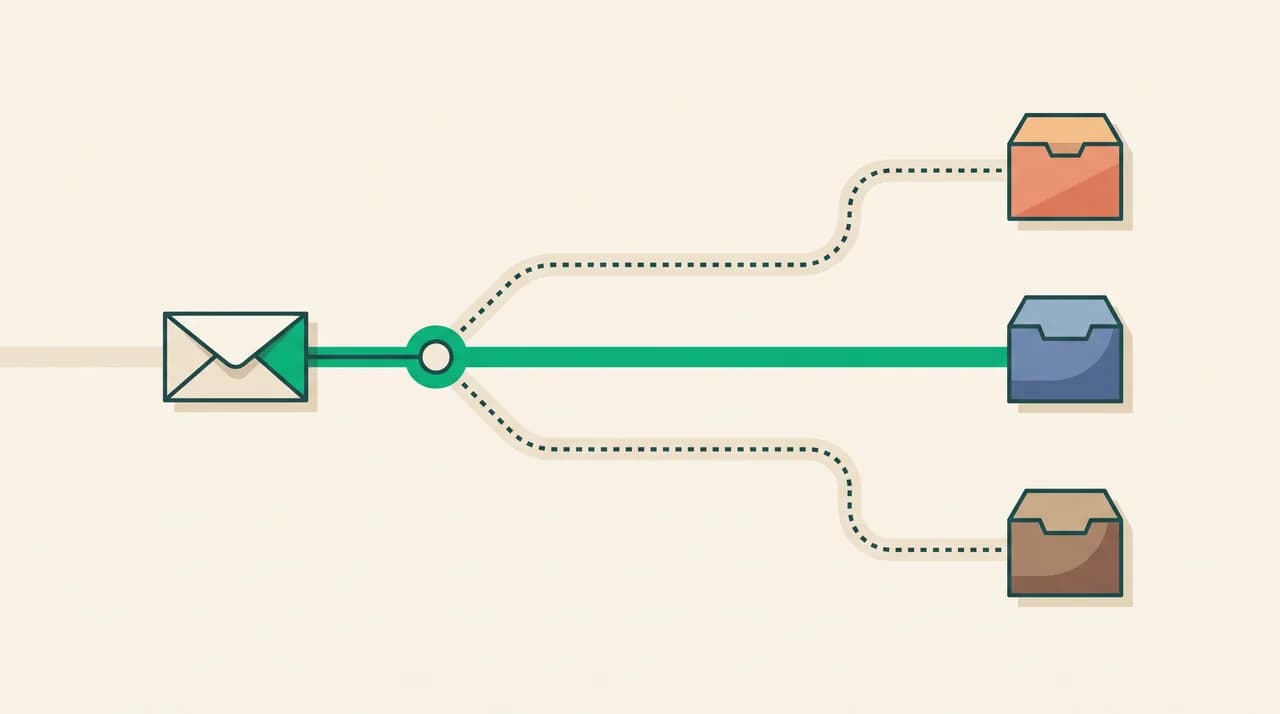
There is no cutover event here, which makes this one of the easier switches you will do. Postbox is not being taken away from you, so nothing has to happen in one sitting.
Run both. Add your accounts to the replacement and use it for a fortnight while Postbox sits untouched on the same machine. With IMAP accounts, both apps read the same server mailbox, so there is nothing to reconcile.
Rolling back means opening the old app again.
Back up first, then trial in parallel
The verdict#
Ranking these honestly means splitting the question. If you want your Postbox setup back — native client, local archive, folders and a search you control — eM Client is the first place to look, because it owns Postbox and publishes an import that finds it for you. Thunderbird is the safest home for the mbox files themselves.
We rank AI Emaily first for a different reader: the person reopening this decision only because they were forced to, who would rather the inbox got triaged and drafted than spend a weekend rebuilding a folder tree.
Either way, copy the profile folder this week. That part is not a preference. AI Emaily is free to try at app.aiemaily.com/signup once your archive is safe.
Frequently asked
See it in AI Emaily
Keep reading
Sources

Written by
Nafiul HasanNafiul Hasan is an entrepreneur and AI automation system builder with 10+ years of experience turning messy, manual workflows into reliable automated systems. He designs and ships AI enterprise solutions end-to-end — the agent logic, the data plumbing, and the product people actually use — and founded AI Emaily to give busy professionals their attention back. He writes here from the builder's seat: what works, what breaks, and how to put AI to work without giving up control.